Many riders hold their breath during transitions, often without realising it. You can usually see it: the shoulders lift slightly and the chest stops moving until the transition is complete.
"Remember to breathe" usually gets lumped in with "relax your shoulders." I see it differently. Breath is a practical riding tool, and it works on your body biomechanically, not just on your nerves.
What your breath is doing
Your diaphragm is part of a pressure system that runs down through your torso to your pelvic floor, with the psoas in between. When you inhale, the diaphragm drops and the pelvic floor moves with it. When you exhale, it comes back up. That movement helps your seat absorb and follow the horse.
When you hold your breath, that system stops moving and your torso stiffens. Your body also starts using your neck and shoulder muscles to help it breathe. That's why holding your breath tends to lock your shoulders, and once your shoulders lock, your hands can't move independently.
Inhale and exhale also do different jobs. An inhale lifts and opens. An exhale settles and stabilises. Neither one is right or wrong. You choose the one the moment needs.
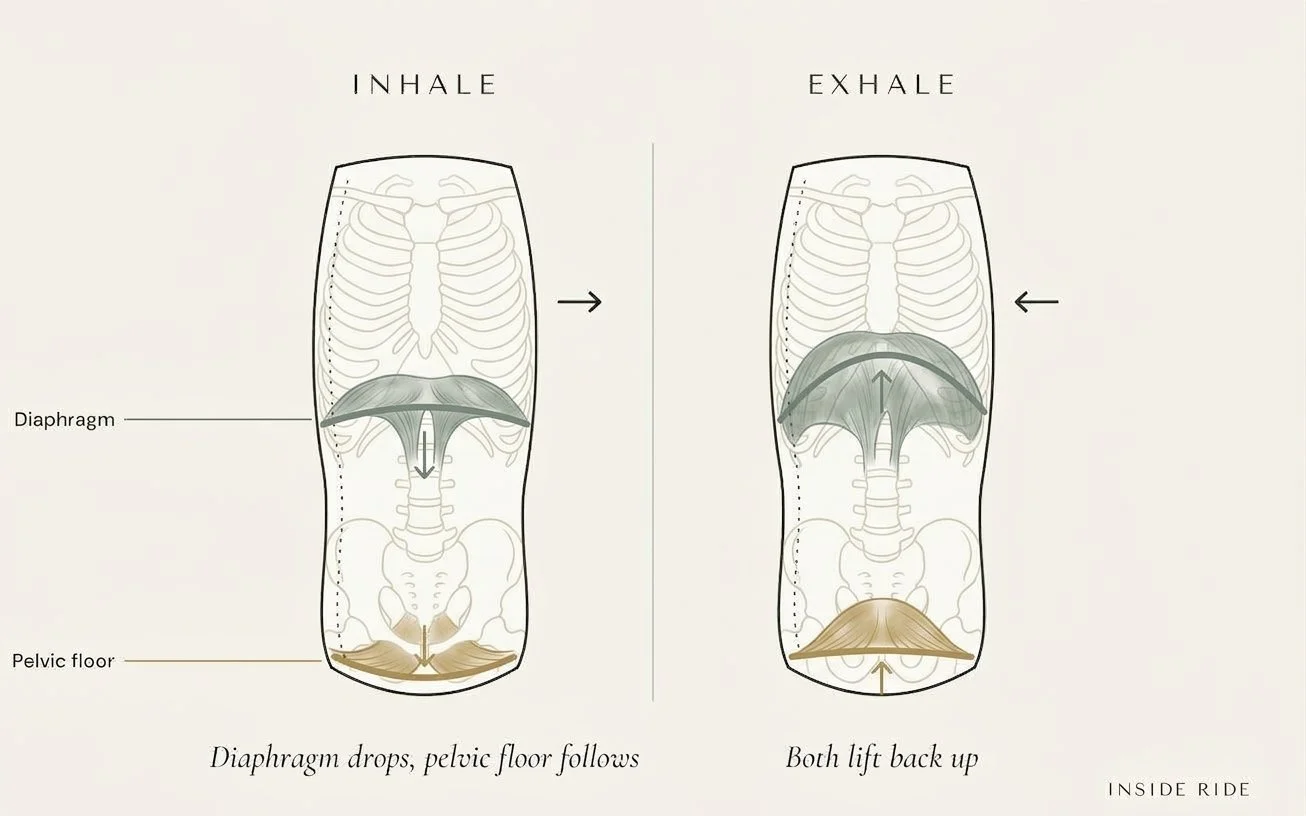
The diaphragm and pelvic floor work in concert: they lower together as you breathe in, and lift together as you breathe out.
There's another layer to this. Your breathing pattern also feeds into your nervous system. A slow, longer out-breath tends to calm things down. Holding your breath, or breathing short and fast, tends to put your system on alert, and an alert nervous system adds tension to your muscles whether you want it or not. That's a bigger topic, and I'll come back to it in a future post.
Where the horse comes in
People often say the horse feels your breath. Here's what's actually happening. Your breath changes the tension in your body, and your seat, legs and hands are in contact with the horse. So when you hold your breath through a transition, the horse feels a stiffer rider at the exact moment you're asking for something.
Try this on your next ride
Try this only when it feels safe for you and your horse, in a quiet spot with a soft contact. Stop if anything hurts or feels wrong. If in doubt, ask your coach, or explore the movement off the horse first.
At halt, breathe in through your nose, then breathe out slowly on a long "sss" or "fff" sound. Notice what happens in your seat as you breathe out. Many riders feel themselves settle deeper into the saddle. It shouldn’t feel like a slump. Your torso keeps its tone and your spine stays long, like a spring that’s slightly compressed and still has movement in it. That elasticity is what we are after.
Then try it in rising trot. Make your out-breath at least one step longer than your in-breath. Don't worry about counting exactly. Just notice what changes in your rising and in your horse's rhythm.
This is where my coaching starts. Breath first, because it changes how you move. How you move is what the horse feels.
Breathe. Move. Connect.
If you'd like to know what your breath is doing in the saddle, here's how working together begins.
