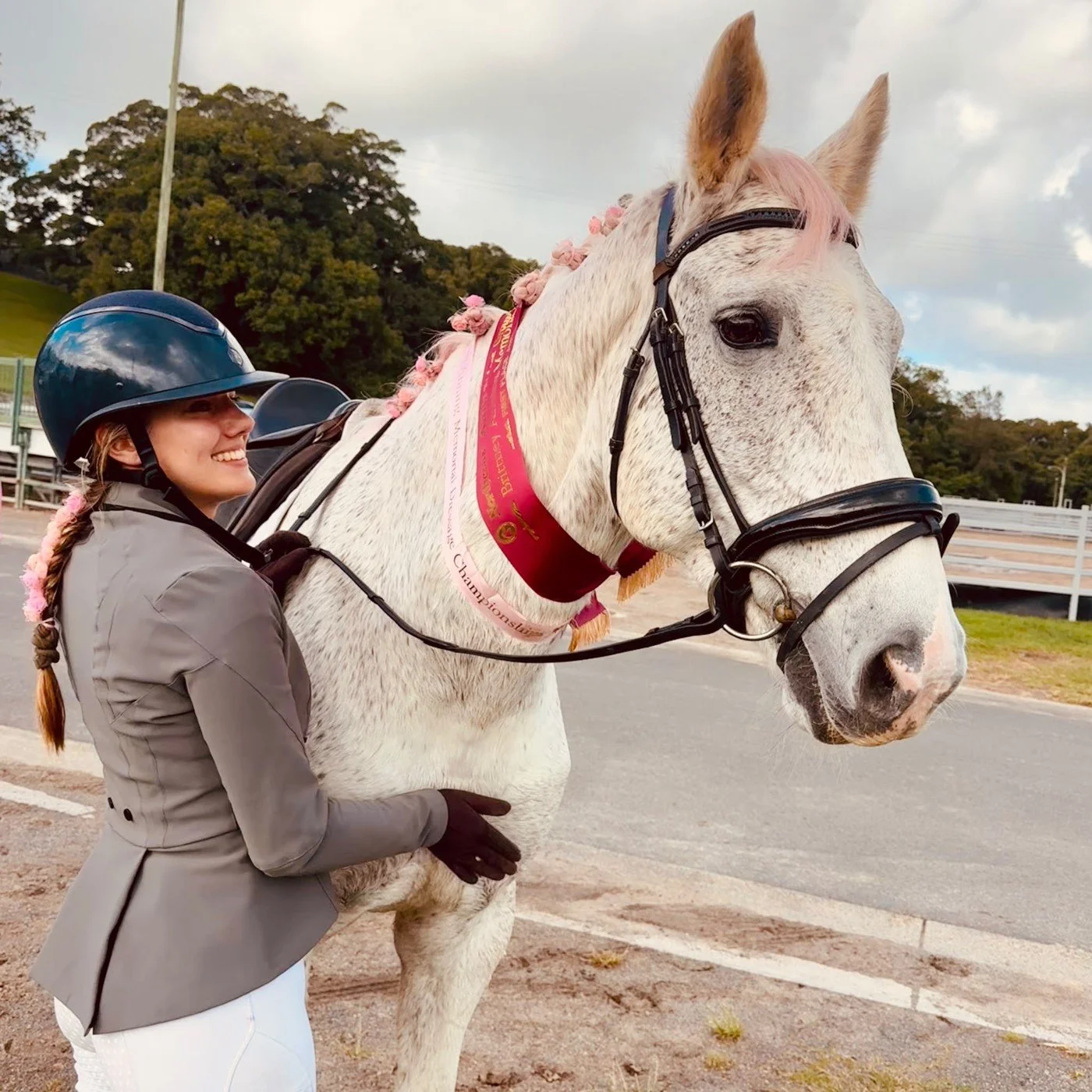
Jana V. and GB at the Brittney Anning Memorial Day, where the riders were invited to accessorise with pink. They committed fully.
Meet the rider
Jana sat on a horse for the first time at five, growing up in Schleswig-Holstein in northern Germany. At 19 she moved to Australia to work, study business and keep riding. Three years ago a dear friend trusted her with Gorgeous Boy, known to everyone as GB.
This year the two of them started competing. They've won several preliminary tests, picked up solid marks at novice, had a first elementary outing with an online test, and train at that level at home.
When I asked Jana for a short intro, she ended it like this: "I'm incredibly grateful for any opportunities to learn and expand our knowledge in this sport." That sentence tells you most of what you need to know about her as a rider.
Why she said yes
Jana first asked me for a lesson or two. She wanted a quieter seat and quieter legs. I told her honestly that two lessons wouldn't get her there. Changing how a body organises itself in the saddle takes time and repetition, not a quick fix. So instead I offered her a four-week seat and leg program, built around those same goals: a deeper seat and quieter leg aids. She had a deeper reason too.
"I promised myself to become a better rider because I probably only have two or three years left with GB before he retires," she told me after our first session. "I'm trying to say here… I'm committed."
Many riders find this kind of work either too scientific or too much like fairy dust. Jana found it neither. She's logical and process-driven, and she wanted to see what the data would show. Within two days of her assessment she had built her own spreadsheet to track every drill, every ride and every benchmark. I've coached a lot of riders. Very few have handed me a planner before I've handed them one.
The starting point
Before any coaching, we took a baseline, both off the horse and on it. Nothing in it can be failed. It's an honest snapshot so that, weeks later, we can see what has changed instead of guessing.
Underneath all of it is a brain-based approach. Your brain decides how much movement it will allow based on the quality of information coming in from three systems: your eyes, your inner ear balance system, and the sensors in your joints and muscles. When any of those sends fuzzy information, the brain plays it safe, and in the saddle that usually looks like tension and grip. So alongside the movement checks, I tested those input systems directly. That included eye convergence, which is how well both eyes team up to focus on something close, and balance with the eyes closed.
Off the horse I checked hip rotation, ankle range, inner thigh ease, upper body rotation, resting breath and standing balance with eyes open and closed.
Fifteen seconds of tapping. At the assessment I took two photos of Jana’s forward reach, 15 seconds apart. In between, I gently tapped her ankle joints. No stretching. The gap closed visibly. Her hamstrings didn’t get longer in 15 seconds. Her nervous system got better information from the joint and decided the extra range was safe to use. That’s proprioception, the sensors in your joints telling your brain where you are in space. It’s one measurement in one moment, but it set the direction for everything that followed.
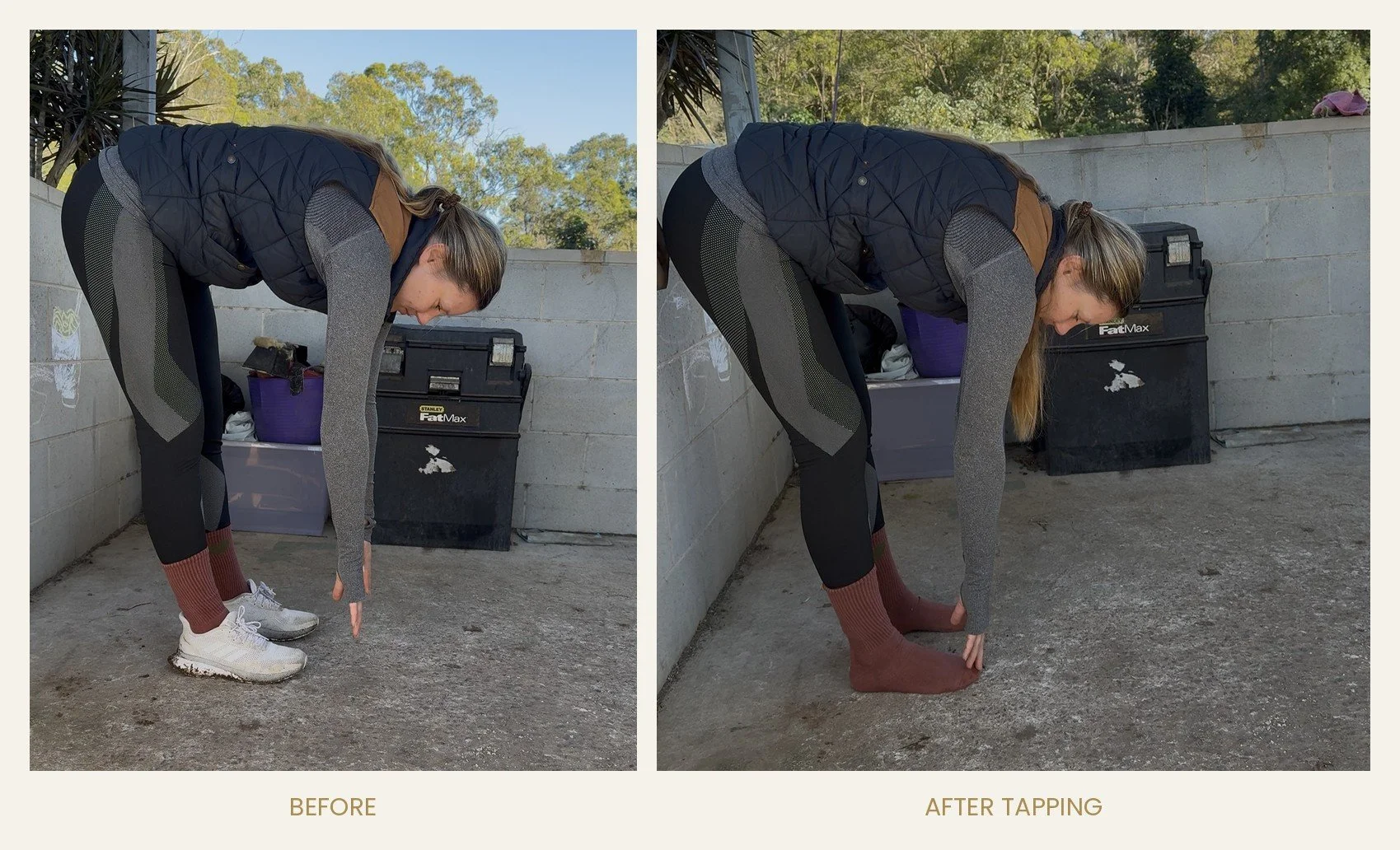
Jana’s forward reach, before and after the ankle tapping. Her shoes came off so that I could reach her ankles. No stretching in-between.
What the tapping told us. Think of your proprioception as your body’s GPS. When the signal is patchy, the brain doesn’t trust the map, so it holds range in reserve to stay safe. A clearer signal from Jana’s ankles gave her more range within seconds, which told me her proprioception mapping needed work. That’s why so much of her saddle work leaned on proprioception tools: the seat bone balls, the mini roller, the stocking with two balls, the exercise bands. Each one sharpens the signal, so her brain can trust the map and her leg can let go.
In the saddle I watched where her leg first gripped, whether her seat followed GB through transitions, how her breath changed from halt to walk, and how many strides it took her seat to settle again. What I saw off the horse played out in the saddle.
Less rotation in the left hip: A back-and-forth sweep through the pelvis in canter, instead of opening and closing at the hip
Less forward range in the left ankle: The left foot rotating rather than sitting square in the stirrup
Right leg less reliable for balance, especially eyes closed: Riding on the toes on the right, knee seeking the knee roll for security
Right eye slightly slower to focus up close: Head tilting right, left shoulder a little high and forward in right canter
Resting breath a touch quick, left shoulder lifting on the inhale: Leg aids that never fully switched off between asks
These weren't five problems. They were one pattern. The right side wasn't yet offering full confidence, so the left side held range in reserve to compensate. That's a nervous system story more than a tight-muscle story, and that matters, because nervous systems can change quickly.
This assessment isn't clinical or diagnostic. I'm not a physiotherapist, exercise scientist or movement scientist. The benchmarks, and the drills I gave Jana, come from my own coaching training in Z-Health, Train Your Seat and breath coaching, and I've found them reliable across many riders. Anyone with ongoing pain or a diagnosis should always see the right professional.
The work
The program ran on two tracks: work on the balance chair at home alongside balance drills, eye drills and breath work, and focused work in the saddle. Each week was built from what Jana's notes and videos showed the week before. The plan was exactly that, a plan, and we adapted it as we went.
The chair work was the Independent Seat Protocol. These are small, slow movements matched to the breath, with movement principles adapted from Eckart Meyners' work: a pelvic clock, a standing leg balance, rotation through the ribcage without side-bending, and seat bone paths for sitting trot and canter. Three times a week, in front of a mirror at first and later without it. I told her it was probably the single most important thing she could do, and she stuck with it, even on the days it felt hard.
The four weeks built like this:
Foundations, breath and vision. A long slow exhale practised off the horse, then used in every downward transition. Short eye drills. Seat bone balls in the saddle to feel where her weight sat unevenly.
Feel it, don't watch it. No mirror on the chair. Humming breath. A mini roller and a stocking with two balls, used briefly in the saddle to sharpen what her body could feel.
Integration. The chair work became one flowing sequence instead of a checklist, and the eye work moved on to a Brock string. Exercise bands in the saddle kept her thighs long and stopped her gripping inwards.
Consolidation. Lining up her knee and big toe towards the bit, stacking the sternum over the pubic bone, and re-asking a question clearly rather than repeating it louder.
In between each stage, there were in-person sessions to measure, film and coach. To show how this worked in practice, here’s a closer look at week 2.
Inside week 2: Feel it, don’t watch it
Week 2 asked Jana's nervous system to trust feeling over watching. That's a bigger ask than it sounds, so I told her up front that some sessions would feel harder before they felt easier. Here's what the week held.
OFF THE HORSE
Balance chair, no mirror. The pelvic clock stayed as the warm-up. Then the torso turned left and right on top of a quiet, forward-facing pelvis. The aim was to stop her ribcage travelling along with her shoulders.
Two pencils. Her eyes jumped between a far pencil and a near one, finding single, clear vision each time. It builds the right eye's ability to switch and settle, and it's the bridge to the Brock string in Week 3.
Standing balance with head turns. Slow turns and nods, feet hip-width apart, an arm's length from a wall. In the saddle your head is never still, and every turn changes what your inner ear and eyes tell your balance system.
Humming breath. A long, steady hum on the exhale, plus a quick, portable physiological sigh. She also tried humming while riding, just to see what changed.
IN THE SADDLE
One proprioception tool per ride. A mini roller behind the sacrum, then between arm and ribcage, then at the thigh. The rule for every one of them: never for the whole ride. One circle in each gait, both reins, then take it off and ride on. You're teaching the feeling, not building a dependency on the tool.
Every ride. An exhale into each transition, and a check of her feet against tripod contact: ball of the big toe, ball of the little toe and heel, pressing evenly like an impression in soft sand.
This week was built around Jana's own assessment. Think of it as a window into the work, not a program to copy.
What changed
The body talking back. By her second week of riding, Jana's ankle was clicking and her ribs were sore. Those were the same places the assessment had flagged. As her leg started to let go and her ribs began to expand with the breath, those spots were the first to give feedback. The rule was simple: clicking without pain is fine, carry on. Anything that pulls towards pain, back off. She did exactly that, and chose an easy walk ride on the days her body or headspace needed it.
"I felt like a bad rider this week." Jana wrote this in her Week 2 notes. What it actually showed was her awareness getting ahead of her habits. She was noticing tension earlier and adjusting before it snowballed, which is a more advanced skill than not noticing it at all.
Lighter and more compact. In Week 3 she rode her test with the bands on. She expected canter to be harder. Instead it felt "lighter and more compact. Hard to explain." The bands kept her straight and her femurs long, so she couldn't grip inwards. GB told her how he felt about that straight away.
GB answering. By our last ride the building blocks were holding. When breath brought the swing back into her pelvis, GB stretched down and over his back within a few strides. Every time her knee and big toe lined up towards the bit, he softened in front. When he resisted, she rebalanced and asked again, cleanly, instead of asking louder. And when he tried to tip her into defensive riding, she noticed it and stopped it sooner than before.
As Jana put it: "It's really interesting to get to feel into my body again without being judged."
A horse is a horse
No program runs in a straight line when there's a horse in it.
Midway through week 3, GB came in with a swollen hind leg. There was no heat and he wasn't moving lame. Jana had ice, cold hosing and clay on it before I'd even suggested it. Rides went on hold for a week, and Jana kept up every off-horse drill while she waited. She asked to restart the week properly rather than pretend it had happened. That's integrity.
Then, a few days before their next competition, GB slipped in the float and split his lip. No show, and weeks off work.
Measuring progress fairly needs like for like: same rider, same horse, consistent work. So we brought the program to a close there. It was nobody's fault. It's how it goes with horses.
I'd argue this part of the story matters as much as the progress. Every rider reading this has had a plan undone by a horse being a horse. What Jana showed is that the off-horse work doesn't stop counting when the riding does. The work she put into her hips, ankles, balance and breath belongs to her, and it doesn't disappear when the horse is in the paddock.
Her first ride back, on a wild windy day, was tense for both of them. My reminder to her is the same one I'd give any rider: don't let go of your aids or your position. Use your breath to tell your own brain and body that it's safe. He'll feel that, and he'll feed off it.
What Jana takes with her
Jana didn't come out of this with a magic fix, and I never offered one. She came out with tools she can find on her own. There's an exhale that settles her seat before a transition. Her thigh can go long instead of gripping. She knows her body well enough to catch tension early. And she has a horse who now answers a clear question.
The finding I'd pick out above all came in Week 2. When the roller came out from under her seat bones, she could still recognise her own position without it. That's the goal of every tool in this kind of work. The tool itself isn't the point. What matters is what's left when it's gone.
A few things I'd want any rider to take from Jana's story:
Your leg can't go quiet while your nervous system is on alert. Breath is the part of that you can reach on purpose.
Soreness and clicking in new places often mean new range, not damage. Pain is the line. Back off before it.
Hard weeks are often awareness weeks. Feeling worse can mean you're noticing more.
The off-horse work is yours. It keeps counting when your horse is in the paddock.
We won't be retesting. Too much time has passed without focused work on the drills for the numbers to say anything fair about the program, and I'd rather be honest about that than put a figure on it. Instead, now that GB is back in work, I've offered Jana an in-saddle lesson to thank her for her commitment and give her a few tips to carry forward.
Breathe first, and the body has room to move. Move freely, and the horse has something to connect with. That's the order Jana worked in, and that's why it worked.
Breathe. Move. Connect.
Yolanda Delport · Inside Ride
