The deeper dive into breath and riding: what it does to your seat, and a few things to try, at home and in the saddle.
You pick up the reins, ask for canter, and somewhere between the thought and the transition your breath goes missing. Your horse notices before you do. When your breathing goes shallow or you hold it, your seat, hands and legs all change a little, and a horse feels every one of those small shifts through the saddle.
In a previous post I said breath is a riding skill, not a relaxation tip. This is the deeper dive. The trouble is that breathing doesn't feel like a riding skill. It feels like something that just happens. But from my coaching view, breath is the first thing I watch. When a rider gets worried or distracted, it shows up in the breathing, and it impacts the rest of the body.
What breath does
Quiet breathing is led by the diaphragm, with help from the muscles between the ribs. When breathing becomes high and effortful, muscles of the neck and chest, including the sternocleidomastoid, the scalenes and the pectorals, join in. When coaching, I see that this often shows up as tension through the neck and shoulders.
The diaphragm is a dome under your lungs. On the in-breath it flattens and drops, and on the out-breath it lifts back up. In quiet breathing it travels roughly a centimetre or two.
The out-breath is mostly passive. Your muscles let go and the lungs spring back. A firm, directed out-breath, like blowing out a candle, is different. It brings in the abdominal muscles and the muscles between the ribs, which pull the ribs down and in.
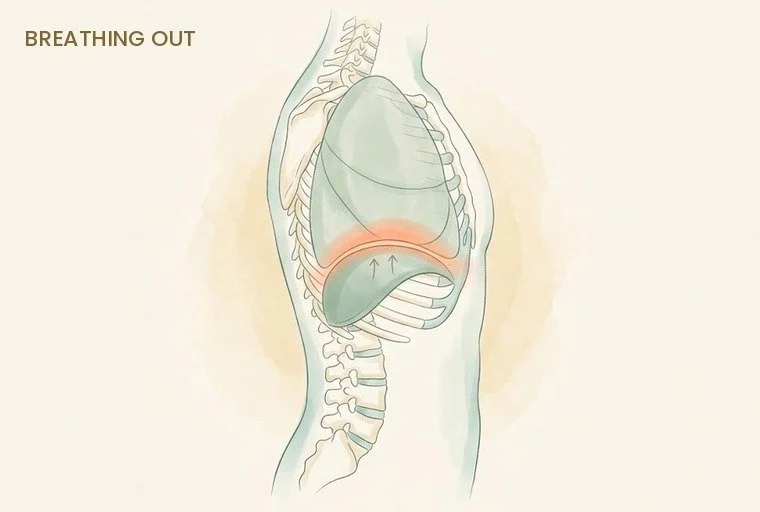
The diaphragm lifts slowly on the out-breath.
Where it comes from
Here's how I picture it. The ribs are not a solid box. As you breathe in, the lower ribs widen out to the sides, a bit like a concertina, and they settle back in as you breathe out. The lower ribs do most of the moving, but the entire ribcage is in motion. Your shoulder blade rests on the back of that moving ribcage, and a muscle called serratus anterior ties the two together. It holds the shoulder blade against the ribs and helps rotate it upward when you lift your arm. When the shoulder blade is held steady, it can also pull on the ribs and help lift them on a big in-breath.
So a stiff ribcage can mean stiff shoulders. And stiff shoulders mean hands that can't follow the horse's mouth.
There's a part that tends to surprise riders. An MRI study of healthy women found that the diaphragm and the pelvic floor move together, both lowering as you breathe in and rising as you breathe out. Here's why that matters in the saddle, in simple terms. When breathing goes shallow and high, that quiet piston action shrinks, and a key part of your stability goes with it. Your hands and knees end up doing work your seat should be doing.
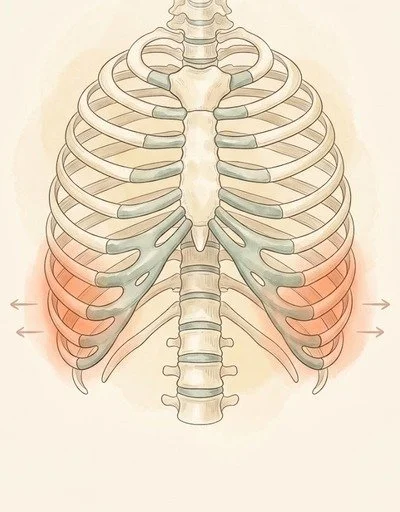
The lower ribs widen like a concertina as you breathe in.
The breath link
This is the Inside Ride layer: breath first.
I use the term elasticity for a body that is neither tightened nor slumped, one that can move and absorb the horse's movement. Moving ribs are a big part of it. When your ribs can widen and settle, your trunk can stabilise and absorb the horse's movement with every stride instead of working against it.
Breath is also how your nervous system hears whether all is well. A large review of slow breathing studies found that it raises heart rate variability, a marker of the calming side of your nervous system. In my coaching, that calm signal tells your body it is safe to move, and it shows up in your seat and hands.
And your horse is listening. In a Swedish study, riders and handlers were told, just before their last pass, that an umbrella would open as they passed a certain point in the arena. It never did, yet the horses' heart rates rose, and the riders' did too. The horses were never told about the umbrella, so the signal came from somewhere. The study doesn't show exactly how, but horse and human seem tuned to each other. Back to my point: your nervous state is the part you can easily work on, and breath is the way in.
Something to try: at home first
Explore every exercise off the horse first. Once they feel easy, take the mounted ones into the saddle, in a quiet spot with soft contact, and only when it feels safe for you and your horse. Stop if you feel dizzy, light-headed or tingly, or if anything hurts or feels wrong, and go back to normal breathing. If you are in doubt, check with a medical practitioner first.
Find your ribs. Sit tall. Rest your hands on your lowest ribs, a hand's width above the waistband, thumbs toward your spine and fingers wrapping round the sides. Breathe in slowly and feel the ribs widen into your hands. Under the skin: the diaphragm helps widen the lower ribcage as it lowers, so you are feeling the ribs do their job. How this translates in the saddle: ribs that can widen let your trunk absorb the horse's movement instead of tightening against it.
Longer out than in. Breathe in through your nose, then breathe out on a quiet "sss" for a little longer than the in-breath. Keep your shoulders heavy. As you breathe out, picture your diaphragm lifting slowly, like a dome. Under the skin: the out-breath is mostly passive, so let it leave rather than pushing it. Slow breathing raises heart rate variability, a marker of the calming side of your nervous system. How this translates in the saddle: a longer out-breath helps your shoulders, hands and seat soften, so your contact stays quieter.
The arm test. Lift one arm forward and up as far as is comfortable and notice where it stops. Drop it to your side. Take a few slow breaths, in through the nose and out for longer, then lift again and compare. Keep the shoulder low. Under the skin: lifting your arm overhead needs the shoulder blade to rotate upward, which is the job of serratus anterior working with the trapezius. How this translates in the saddle: it shows how freely your shoulder and ribcage move, which is what lets your hands stay independent of your seat.
Concertina. Sitting tall, breathe into your sides and let your ribs open like a concertina. Let the exhale draw them back in. Picture your lower ribs swinging out to the sides. Under the skin: your lower ribs hinge at the spine and swing out to the sides like bucket handles, as the diaphragm and the muscles between the ribs work together. How this translates in the saddle: ribs that move in all directions keep your trunk supple, so you can move with the horse more effectively.
Hum and march. March on the spot while humming a tune, then switch to a small bounce without losing the tune. If the hum stops, so did your breath. Under the skin: a hum is a steady out-breath you can hear, so you know the moment it stops. Side fact: the vagus nerve, a main nerve of the calming side of your nervous system, runs past your voice box, and a long, steady hum is a simple way many people settle themselves. How this translates in the saddle: just hum, and let your horse do the marching. Breath can easily disappear in trot and canter, especially in upward transitions.
Partner ribs, optional, with a friend. Your partner rests both hands lightly on your lowest ribs, at the sides and back. Breathe in slowly and let your ribs widen into their hands, then breathe out on a quiet "sss". Then swap. Under the skin: your partner's hands give your brain something to feel, so the movement of your lower ribs becomes easier to notice. How this translates in the saddle: once you can feel your lower ribs move, you can find the same movement on your own, where nobody can put a hand on your ribs. Full rib expansion matters because it keeps your trunk elastic and lets the diaphragm and pelvic floor share the work of supporting your seat. When the ribs stay still, your shoulders and hands end up doing it instead.
Then take it into the saddle
Start in walk, in a quiet spot. Once these feel easy, carry them into the higher gaits.
Long exhale at halt. You may have met this one in a previous post. Before you walk on, breathe out slowly on an "sss" and let your seat soften into the saddle. Don't collapse or slump on the exhale. Think of keeping your spine tall. Why: a soft out-breath lets your seat settle, so the horse gets a calmer start.
Whisper the leg aid. Before a leg aid, breathe in as you prepare, then breathe out softly as your leg asks. Keep the exhale easy and the leg light, as if you were whispering the aid. Why: from my coaching view, it helps stop tension pulling your leg up, which means you would have to use more pressure.
Blow the candle into the turn. Breathe out as if you were blowing a candle flame sideways as you ride into a corner or circle. Why: a firm, directed out-breath brings in the abdominal muscles, so it helps engage your core and keeps your torso from collapsing through the turn.
Band around the ribs. Tie a soft, stretchy band around your ribcage, not too tight, just enough to give your ribs something to lean into when you inhale. Why: the gentle resistance makes the widening of your ribs as you inhale easier to feel while you ride.
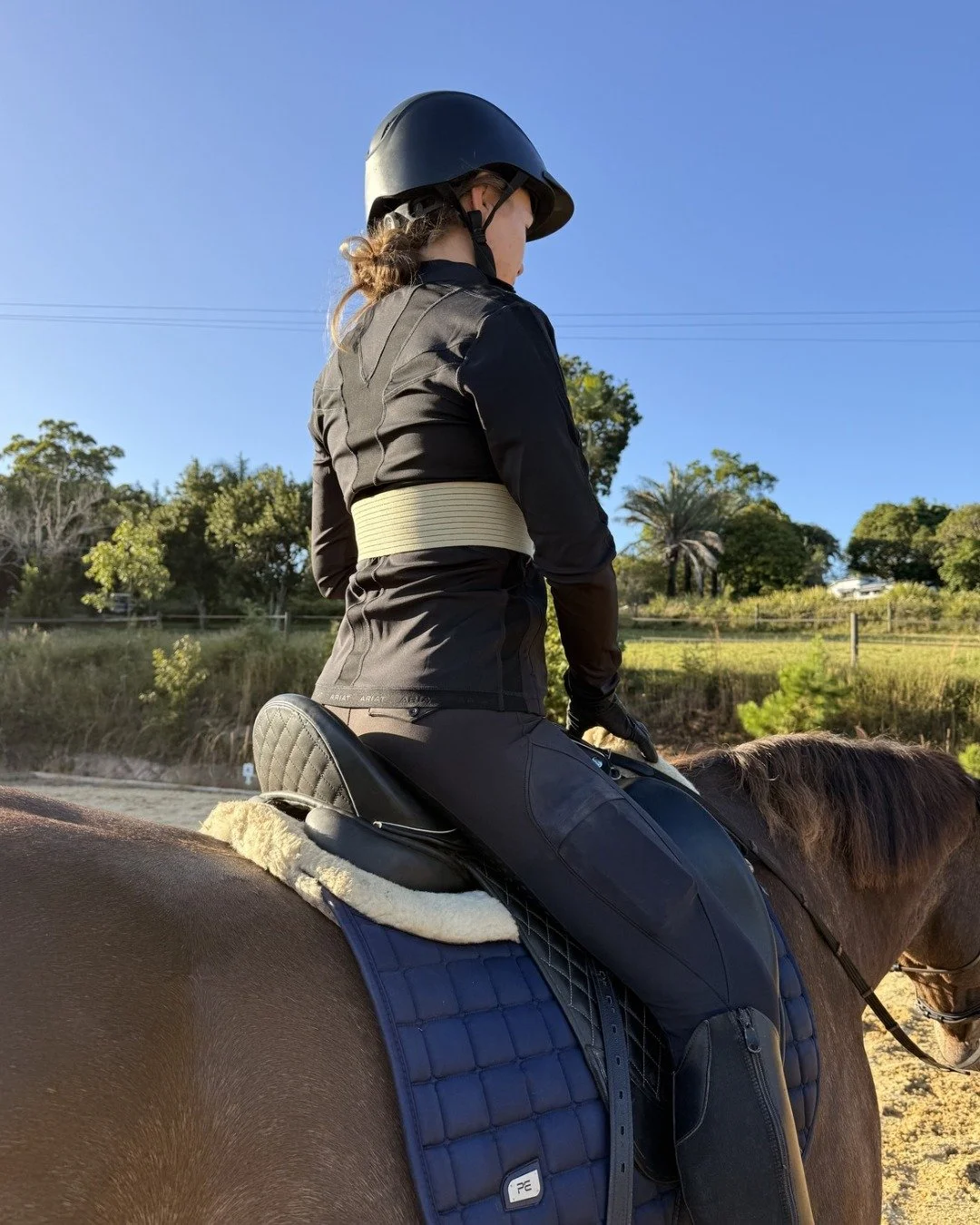
A soft, stretchy band gives your ribs something to lean into.
Last, notice what your horse does. A horse that softens through the back or lets out a big sigh is telling you the change in your breath has travelled through your body and into theirs.
A note of caution. If you feel light-headed, you are probably breathing bigger or faster than you need to. Breathing too much drops your carbon dioxide, which is what brings on dizziness and pins and needles. Go smaller, slower and quieter.
If you would like help finding your breath on a horse, get in touch through the Contact page.
Sources and influences: Keeling, Jonare and Lanneborn, The Veterinary Journal, 2009 (the umbrella study). Talasz and colleagues, International Urogynecology Journal, 2011 (diaphragm and pelvic floor on dynamic MRI). A systematic review and meta-analysis of voluntary slow breathing and heart rate variability, Neuroscience and Biobehavioral Reviews. Anatomy checked against Physiopedia, StatPearls and a Johns Hopkins respiratory physiology resource. The breath-first approach and the exercises above are how I coach it at Inside Ride.
Thank you to the rider who kindly allowed me to use these photos.
