Almost every rider has a preferred side. Not a good side and a bad side, just the one the body chooses. The tricky part is that it usually feels like the middle.
What the research shows
Dr Russell MacKechnie-Guire and his team at Centaur Biomechanics have measured riders on pressure mats. In their seated studies, riders tended to put more weight through the left seat bone, even when they felt completely straight.
That matters because your horse feels where your weight lands, through the saddle, every stride.
And the load isn’t small. MacKechnie-Guire’s figures show the force on the horse’s back rising with each gait, so a seat bone bias that seems minor in walk is carried with more force in trot and canter.
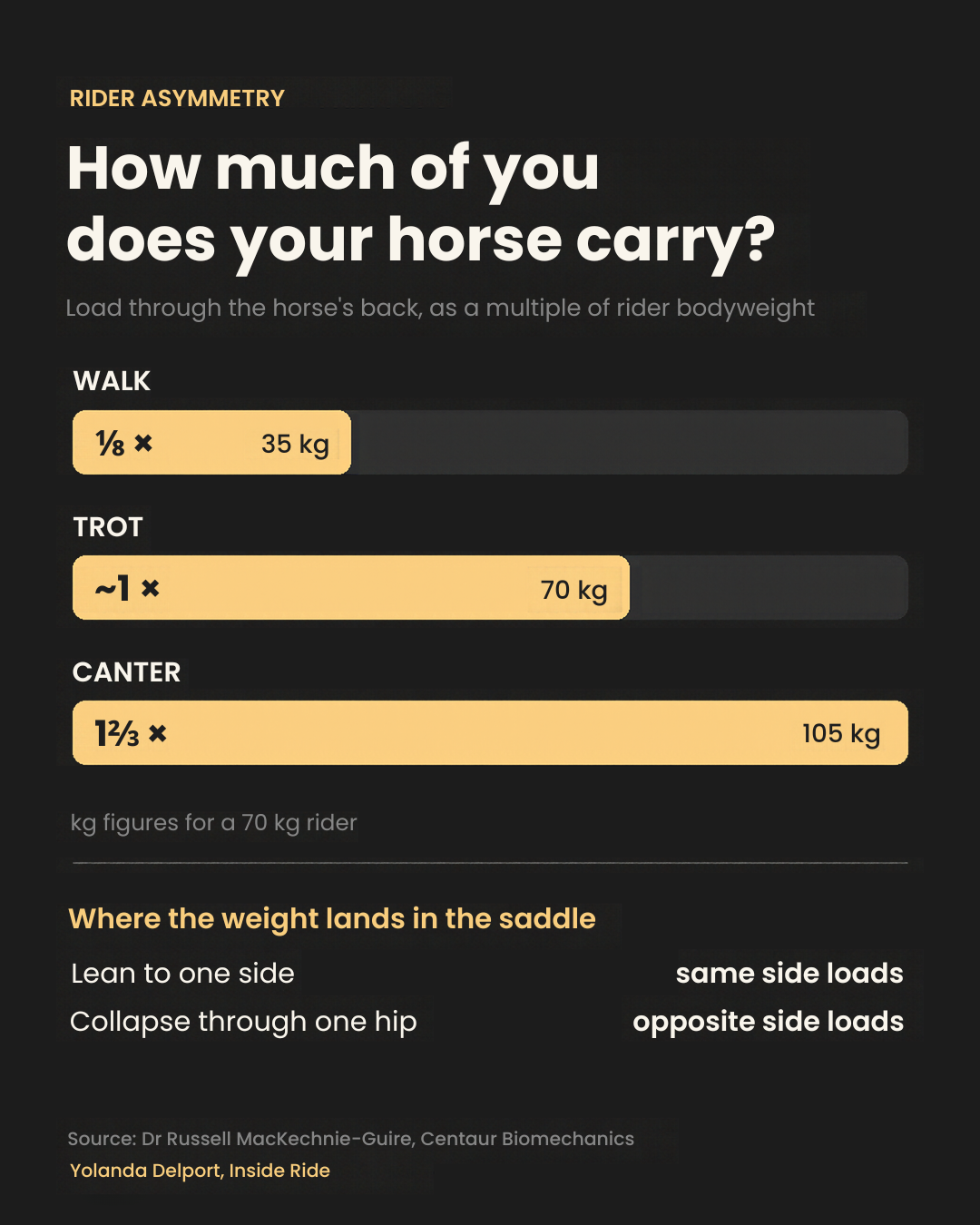
Rider load on the horse’s back by gait. Figures from Dr Russell MacKechnie-Guire, redrawn by Inside Ride.
Lean or collapse? They load opposite sides
This one catches people out. Research by Gunst and colleagues, measuring saddle pressure in 80 horse and rider pairs, found:
If you lean your upper body to one side, more pressure lands on that same side of the saddle.
If you collapse through one hip, more pressure lands on the opposite side.
So a rider collapsing to the left is often sitting heavier on the right. If you’ve been told to “sit more to the inside” and it never quite worked, this may be why.
It rarely shows up alone
MacKechnie-Guire makes the point that these show up as one pattern, not separate faults. In my own coaching I see it like a row of dominoes: the collapse tips first, then the opposite hip slides out, a knee grips, one hand drifts across the withers and that rein gets heavier. Chase the last domino and nothing changes. Find the first one and the rest often settle on their own.
Something to try on your next ride
Try this only when it feels safe for you and your horse, in a quiet spot with a soft contact. Stop if anything hurts or feels wrong. If in doubt, ask your coach, or explore the movement off the horse first.
On a 20 m circle, put both reins in your outside hand. (This is a test MacKechnie-Guire uses, and it’s a good one.)
Ride a full circle and watch where the horse goes.
If the horse tracks the circle better, the inside rein was doing more than you thought, and your seat may be the reason.
If nothing changes, the crookedness is coming from somewhere else, and that’s useful to know too.
Then add the Inside Ride layer: breath. Walk a circle on each rein and notice which side of your ribcage fills first as you breathe in. You may find the breath favours your preferred side too. Send the next few breaths into the quieter side and feel whether your seat bones even out.
Off the horse, sitting on a gym ball and rolling your pelvis slowly in small circles (another MacKechnie-Guire favourite) lets both seat bones take turns. Pair each circle with a long exhale and it helps your body find a middle it doesn’t have to hold.
“Straightness starts with the rider” is one of the themes in my half-day clinics. Get in touch to bring one to your club.
Sources
MacKechnie-Guire, R. Rider asymmetry and the horse. Centaur Biomechanics webinar.
Gunst S. et al. (2019). Influence of functional rider and horse asymmetries on saddle force distribution during stance and in sitting trot. Journal of Equine Veterinary Science 78:20–28. https://doi.org/10.1016/j.jevs.2019.03.215
