Many riders spend years looking for the right position and trying to hold it. Here's what a seat that absorbs the movement and rebalances gives your horse, and how breath keeps the conversation going.
Ask a room of riders what they're working on and plenty will say "sitting up straighter". We picture a tidy line from ear to hip to heel and we try to place ourselves on it, a bit like hanging a coat on a hook. When I talk about your seat, I mean all of you in the saddle, from your head to your heels, not only your pelvis.
The trouble is the horse never stays still long enough for the coat to hang. Every stride sends a wave up through the rider's body, from the pelvis to the spine, shoulders and head, and a seat that has been held in place has nowhere to absorb that wave. A seat with elasticity can take it in, soften around it and pass it on.
A conversation with room for quiet
Riding is a conversation that happens almost entirely without words, apart from the occasional click or word of encouragement. You ask with your body, your horse answers, you absorb what came back, and you may adjust. Then comes my favourite part, which is the quiet. Once your horse has listened, the kindest thing you can do is stop applying the aid and enjoy the comfortable silence, until a reminder or a new request is needed.
That silence only works if your seat can receive the answer, and receiving takes a body that is free to move. A rider held in one position can still ask, but when the reply arrives the body can’t absorb the movement, and the conversation tends to spiral into tension. An elastic seat lets the aids travel clearly and lets you feel the answer, so you can go quiet. Elastic doesn’t mean floppy. It means enough tone to absorb the movement, so you can feel the answer. A reminder or a new request comes only when it’s needed, and your horse learns that the quiet means “right answer, well done”.
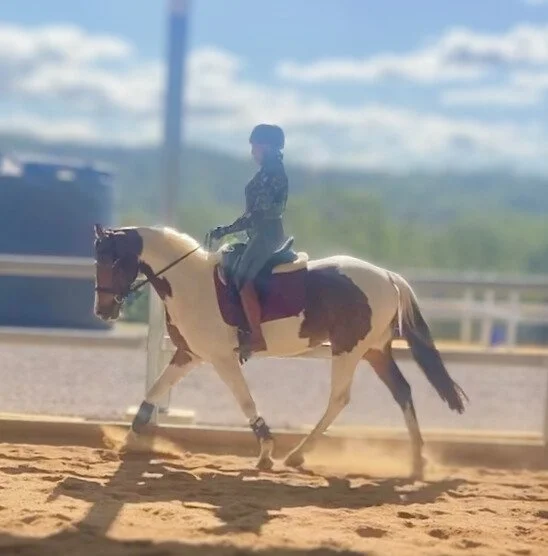
An elastic seat lets you feel the answer, and the aids go quiet.
When the conversation gets loud
Not every ask gets an answer straight away, and not every ask gets the answer you wanted. That’s normal. You ask quietly. When the answer doesn’t come, you add a little more clarity to the ask. When the right answer comes, you go quiet, and after a couple of moments, test the quiet aid again. That’s a healthy conversation.
Tension in your seat often means you can’t feel the soft answer. When you ask, there’s a small pause before your horse responds, and a tight seat can’t feel that. So you read it as no response, you ask again, and you end up asking for something your horse is already giving you.
Tension also takes away your volume control. With a soft seat, your aids can start quietly. With a tight one they can’t, so the very first ask is already a big one, with nowhere quieter to go. From there it only builds. The next ask is firmer, then sharper, until the whole conversation is shouting. And your horse learns something we never meant to teach: the answer only counts on the second, third or fifth ask, and only when it’s loud.
This is the moment for a breath reset. A slow exhale lets the ribs soften, the seat becomes elastic again, and you can start the conversation over from a quieter place.
There are plenty of variables in real life, including your horse’s training, the clarity and timing of your aids, and whatever the arena and the weather throw at you. That’s the reality of riding, and it’s why I like this as a place to start rather than a promise of perfection. You ask, your horse responds, and you keep the conversation going.
Where it comes from
Here's how I picture it. Think of a buoy in a harbour. It doesn't hold still, yet it stays upright, because it keeps answering every swell with a tiny adjustment. Your seat is the buoy and your horse is the water. The aim is to keep responding, and the stillness you see from the ground is the result of all that small, quiet movement underneath.
The breath link
This is the Inside Ride layer: breath first. Breath is the one part of your nervous system that runs on its own and also lets you step in on purpose. A slow, easy exhale tells your brain that all is well, the ribs are free to widen and soften in every direction, and the spine and pelvis follow along. A held breath sends the opposite message, and your brain holds on to everything else as well.
Once the ribs are moving, your whole trunk has a rhythm to share with the horse's stride. James Nestor's Breath is a super read if you'd like to dig into why this works so well.
Something to try on your next ride
Try this only when it feels safe for you and your horse, in a quiet spot with soft contact. Try to find the movement off the horse first. Stop if anything hurts, you feel dizzy or something feels wrong. If in doubt, always refer to a medical practitioner.
Off the horse first, place your hands on the sides of your lower ribs and feel them draw down and in as you breathe out, and widen again as you breathe in. If the breath stays high in your chest, send it to your hands.
In walk on a long rein, soften your gaze and breathe out slowly. As the air leaves, let your ribs draw gently down and in, and widen again as you breathe in. Let your pelvis follow the movement of your horse’s back.
Ask for something small, such as a little more energy, and keep your breath moving while you ask. When the answer doesn’t come, add a little more clarity to the ask. When the right answer comes, let the aid go and enjoy the quiet while your ribs keep moving. After a couple of moments, test the quiet aid again.
If things get louder, from you or from your horse, take a long exhale and start the conversation again from a quieter place. Once you get a response you like, build on it, and offer a reminder or a new request only when you need to.
If your breath keeps getting held, go back to walk on a long rein and make your asks smaller.
The aim is a seat that absorbs your horse’s movement and sends it on, so the conversation with your horse can keep going, quiet moments included.
Find that full breath off the horse with a short voice note, then take a Pocket Cue to the yard to prompt it as you climb on.
Sources and influences: James Nestor, Breath. The breath-first approach and the exercise above are how I coach it at Inside Ride.
